
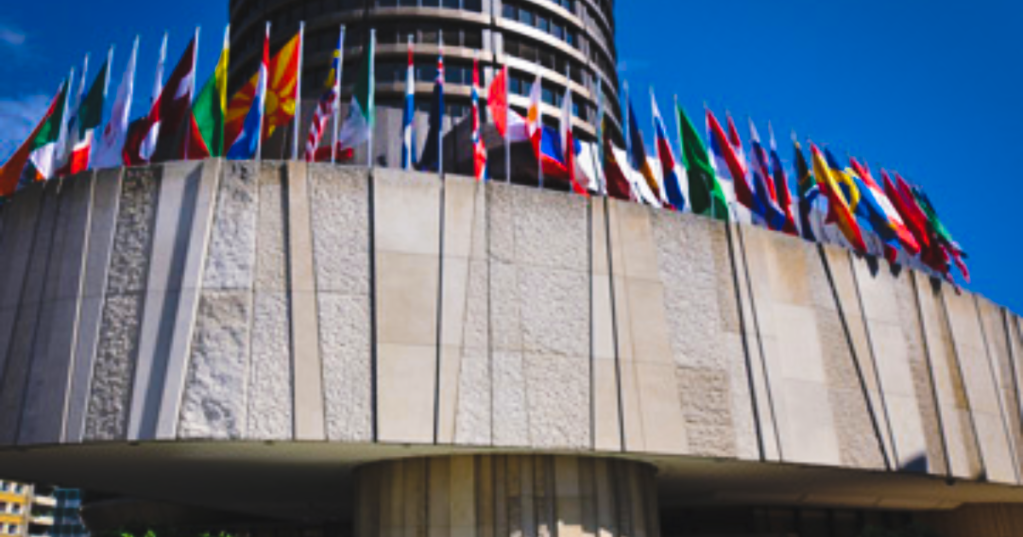
Few institutions wield as much quiet influence as the Bank for International Settlements (BIS), tucked away in Basel yet central to the world’s financial order. Known as “the central bank of central banks,” its reach spans continents, shaping monetary policy, banking regulation, and—by extension—the financial reality of billions.
Founded in 1930, the Bank for International Settlements sits at the intersection of economics, law, and geopolitics. It has no democratic oversight, enjoys diplomatic immunity, and hosts closed-door meetings that decide the frameworks under which banks worldwide must operate. The BIS’s influence is not enforced through law or military might, but through soft power—the kind that defines the architecture of the global economy itself.
The history of the BIS
The Bank for International Settlements (BIS) was created under the Hague Agreements of 1930, born from the Young Plan to manage Germany’s post–World War I reparations and restore financial stability to Europe. Its founding members—Belgium, France, Germany, Italy, Japan, the United Kingdom, and the United States—chose neutral Switzerland as its base, opening in Basel on 17 May 1930. Guided by figures such as Owen D. Young and Montagu Norman, the Bank was envisioned as a permanent forum where central banks could coordinate policy beyond the reach of political governments.
In its early years, the BIS quietly fostered monetary cooperation across Europe, though its neutrality was tested during World War II, when it maintained limited operations under Swiss neutrality. The Bank’s wartime dealings later drew scrutiny, and at the 1944 Bretton Woods Conference, delegates even proposed its dissolution. Yet it survived, reinventing itself as a postwar platform for monetary coordination and the rebuilding of Europe’s financial systems.
A turning point came in 1974, after the failure of Germany’s Bankhaus Herstatt exposed weaknesses in cross-border regulation. Under BIS auspices, central banks formed the Basel Committee on Banking Supervision, launching the institution’s transformation from discreet mediator to global standard-setter. The Committee’s subsequent frameworks—Basel I (1988), Basel II (2004), and Basel III (2010–present)—have defined how banks worldwide manage capital, liquidity, and risk.
The BIS’s coordinating role deepened during crises such as the 1982 Latin American debt crisis and the 2008 global financial crisis, when it helped orchestrate liquidity support and policy alignment among central banks. In 2019, it expanded its mission through the BIS Innovation Hub, driving research on digital currencies and financial technologies. Today, its 63 member central banks and monetary authorities, representing around 95% of global GDP, continue to meet in Basel to align global monetary policy.
The BIS has evolved from a postwar settlement agent into the quiet architect of international finance. Its continuity and influence rests on the legal privileges and inviolability that guarantee its independence—foundations that, in turn, enable its unique form of soft power in the global economy.
Legal inviolability
The BIS’s privileges are defined primarily in the Headquarters Agreement between the Swiss Federal Council and the Bank for International Settlements and further reinforced in its Statutes (most recently amended in 2022). Together, these instruments establish the Bank’s unique legal and operational status.
Inviolability in international law means complete protection from the host state’s jurisdiction. No Swiss authority may enforce national law on Bank for International Settlements grounds or compel testimony or records. The BIS exists legally outside Switzerland even as it stands at Basel’s centre.
The following provisions are drawn from the Headquarters Agreement:
- Article 2 – The Swiss Federal Council guarantees the Bank “the autonomy and freedom of action to which it is entitled as an international organisation,” including “absolute freedom to hold meetings, including freedom of discussion and decision.”
- Article 3 – The Bank’s buildings, premises, and surrounding land “shall be inviolable,” and no Swiss authority may enter without its consent. Its archives, documents, and data media are likewise “inviolable at all times and in all places,” with the Bank retaining full supervisory and police authority over its premises.
- Article 4 – The Bank enjoys immunity from jurisdiction and from all measures of execution concerning its property and assets, except where such immunity is expressly waived or in narrowly defined cases such as civil suits, vehicle-related damage, or arbitration proceedings.
- Article 5 – The Bank’s official communications “shall not be subject to censorship” and may use codes, couriers, and data media enjoying diplomatic privileges, with treatment at least as favourable as that granted to other international organisations in Switzerland.
- Article 7 – The Bank, its assets, income, and property are exempt from all direct and indirect federal, cantonal, and communal taxes, except for charges related to specific services rendered. This exemption extends to operations conducted outside the Swiss market or in the interest of international monetary cooperation.
- Article 12 – Members of the Board of Directors and representatives of member central banks enjoy immunity from arrest, jurisdiction, and seizure of personal belongings for acts performed in the course of their duties. They also receive diplomatic customs privileges, exemption from immigration and national service obligations, and the right to use codes or couriers for official communications.
- Article 14 – Officials of the Bank, regardless of nationality, enjoy immunity from jurisdiction for official acts and exemption from federal, cantonal, and communal taxes on their salaries, allowances, and capital payments made by the Bank, subject to internal taxation arrangements.
Together with the core immunities outlined above, Articles 19 and 22 clarify the purpose and limits of these privileges. They emphasise that the Bank’s immunities are not for the personal benefit of officials, but exist to safeguard the Bank’s freedom of action and the independence of its personnel in carrying out their duties. At the same time, the Agreement provides mechanisms to waive immunity when it would impede the course of justice and establishes a framework for cooperation with Swiss authorities to prevent any abuse of the Bank’s privileges and exemptions. This balance ensures that while the BIS maintains its operational autonomy, it remains accountable within the Swiss legal framework.
Structure and membership
63 central banks and monetary authorities are currently members of the Bank for International Settlements and have rights of voting and representation at General Meetings. Shareholders include the U.S. Federal Reserve, the European Central Bank, the Bank of England, the People’s Bank of China, and nearly every other major monetary authority. Collectively, BIS members account for around 95% of global GDP.
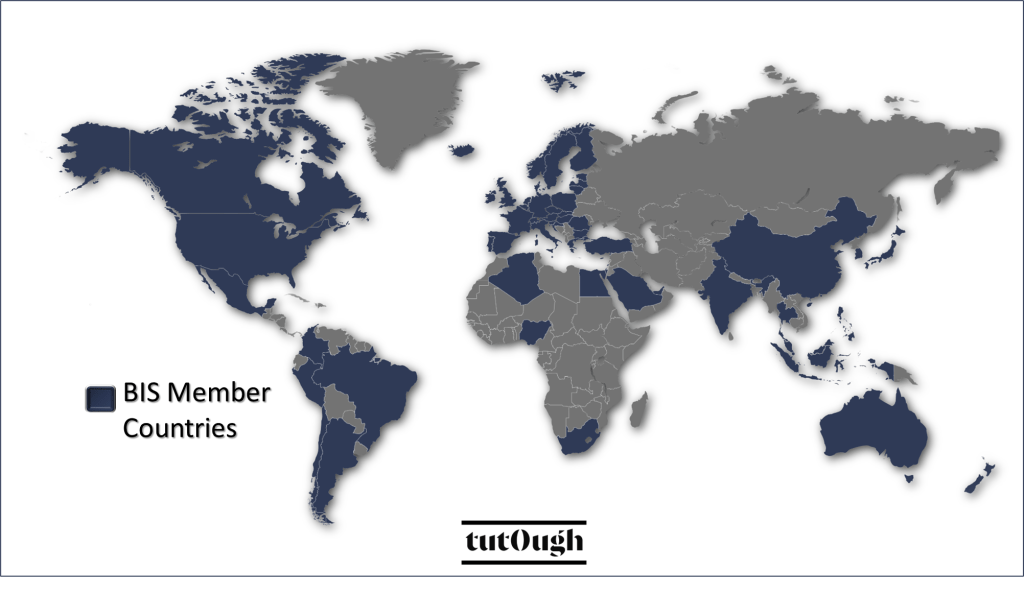
The Bank for International Settlements serves as a bank for central banks, holding about $240 billion in deposits and managing a balance sheet exceeding $350 billion (BIS Annual Report 2024). The institution employs roughly 600 staff across Basel, Hong Kong, and Mexico City.
Every two months, central bank governors gather privately in Basel. No minutes are published; no press invited. Yet these “Basel meetings” often precede key monetary shifts—such as coordinated rate decisions or liquidity measures—later mirrored in national policy. In a rare departure from its tradition of discretion, the BIS opened its doors to the public in 2021 for its “BIS 90 Years” exhibition, welcoming the people of Basel and beyond to explore its history, mandate, and global role (BIS, 2021). The exhibition, which included archival displays and interactive installations, offered a glimpse inside an institution that typically operates far from public view—a symbolic gesture of transparency from the world’s most private bank.
Beyond such events, the Bank for International Settlements maintains sections on its website for press releases, research, publications, and bulletins, providing ongoing access to its analyses and policy insights for the broader public.
The soft power of the Basel Committees
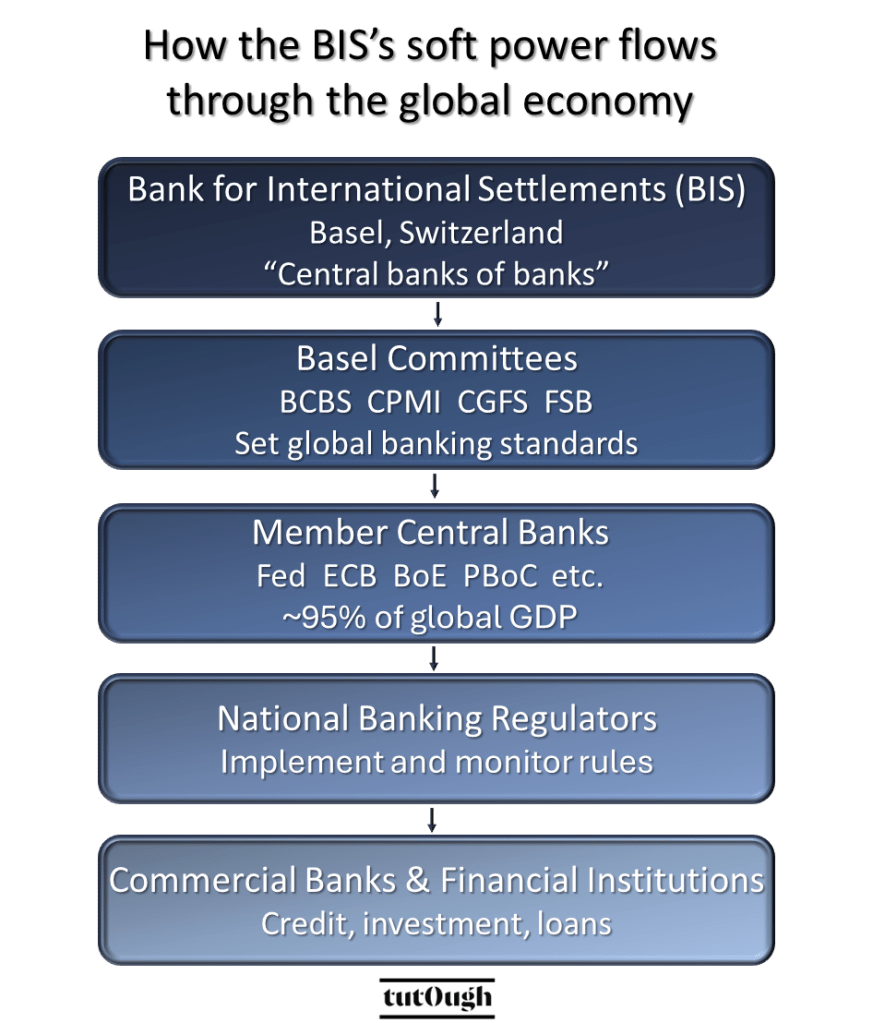
The BIS’s soft power operates through its committees—most famously the Basel Committee on Banking Supervision (BCBS), established in 1974 after the collapse of Bankhaus Herstatt triggered The BIS’s influence flows through its committees, which operate as the technical architecture of global finance.
- Basel Committee on Banking Supervision (BCBS): Founded in 1974, it sets international banking standards, including the Basel I–IV Accords, which dictate capital, liquidity, and leverage ratios.
- Committee on Payments and Market Infrastructures (CPMI): Oversees global payment systems and cybersecurity protocols.
- Committee on the Global Financial System (CGFS): Monitors systemic risk and cross-border capital flows.
- Financial Stability Board (FSB): Formed after 2008, coordinates regulation of “systemically important” banks.
Though officially non-binding, these standards are functionally mandatory for countries wishing to remain credible in international markets. In effect, the Bank for Internaional Settlements serves as a global regulator without legislative power, setting rules that national regulators later enforce.
Governance and statutes
The BIS Statutes provide a rare glimpse into how this institution governs itself. They define its purpose, decision-making, and shareholder structure—with precision and autonomy unmatched by most international bodies.
- Article 3 – The BIS’s mission is “to promote the co-operation of central banks and to provide additional facilities for international financial operations; and to act as trustee or agent in regard to” specific matters.
- Article 21 – The Board determines the nature of the Bank’s operations, which may include buying, selling, and holding gold; making advances to or borrowing from central banks; discounting, rediscounting, and trading short-term obligations and securities; maintaining accounts and accepting deposits from central banks; acting as agent or correspondent for central banks; and entering agreements to act as trustee or agent in connection with international settlements.
- Article 24 – The Bank may not issue notes payable at sight to bearer, accept bills of exchange, make advances to governments, open current accounts in the name of governments, acquire a controlling interest in any business, or retain real property longer than necessary to realise it for proper advantage, except as needed for the conduct of its own operations.
- Article 27 – The Board of Directors is composed of the Governors of the central banks of Belgium, France, Germany, Great Britain, Italy, and the United States as ex-officio Directors; one jointly appointed director from these central banks; and up to 11 directors elected by the Board from other subscribing central banks. Directors may appoint alternates and accompanying persons for Board meetings, and decisions requiring a two-thirds majority also need a simple majority of the ex-officio Directors.
- Articles 55–56 – The Bank enjoys immunity from jurisdiction and from all measures of execution concerning its property, assets, deposits, claims, and shares, except where such immunity is formally waived or in defined civil or commercial cases. For these Statutes, “central bank” refers to the institution regulating currency and credit in a country or monetary zone, “Governor” denotes the person directing policy and administration, and a two-thirds Board majority means at least two-thirds of all directors’ votes.
The BIS operates like a private corporation with sovereign privileges, uniting public mandates with private governance. Its shareholders are public institutions, but its accountability mechanisms are internal—a dual identity that makes it uniquely powerful.
Geopolitical influence
The BIS’s reach extends well beyond finance. Its ability to convene competing powers in one neutral setting has made it a subtle yet crucial geopolitical bridge.
During the 2008 financial crisis, it facilitated emergency dollar-swap lines between the U.S. Federal Reserve and foreign central banks. During COVID-19, it coordinated monetary stimulus and liquidity measures.
Its 2024 Annual Report noted that “central banks must maintain coordination amid fragmenting geopolitics,” reflecting its self-perceived role as a stabiliser in a divided world.
China, the U.S., and the EU all maintain active participation through the Bank for International Settlements framework—even amid rising tensions—demonstrating that monetary cooperation often survives where diplomacy fails.
Quantitative scale of influence
| Metric (2024 est.) | Value |
|---|---|
| BIS member central banks & monetary authorities | 63 |
| Share of global GDP represented | ~95% |
| BIS balance sheet size | ≈ $350 billion |
| Central-bank deposits at BIS | ≈ $240 billion |
| BIS staff | ~670 across Basel, Hong Kong, Mexico City |
| Basel Accords adoption | Over 120 jurisdictions |
These numbers illustrate that while the Bank for International Settlements directly employs only hundreds, its frameworks influence hundreds of thousands of financial institutions and billions of daily transactions.
Through this cascade, decisions made in a single tower in Basel ultimately shape how credit is extended, how currencies are valued, and how risk is priced worldwide.
The everyday impact
Most people have never heard of the BIS, yet its influence extends into daily life. The capital-adequacy rules it sponsors affect how much banks can lend for mortgages, business loans, or credit cards. Liquidity requirements influence interest rates and bank fees.
In effect, the BIS’s decisions help determine the cost and availability of money itself. When the Basel III reforms tightened capital rules after 2008, many commercial banks reduced lending to small businesses—stabilizing the system, but slowing recovery in several economies.
The BIS also plays a key role in research on central bank digital currencies (CBDCs). Its Innovation Hub—launched in 2019—coordinates pilot projects exploring programmable money and cross-border digital payments, potentially reshaping how people transact globally.
Transparency and criticism
The BIS’s power and secrecy have drawn both admiration and concern. The Statutes and Headquarters Agreement codify privileges that exempt it from nearly all national oversight. The 2024/25 Annual Report defends this structure as vital to neutrality: “Independence from political cycles ensures consistency in promoting monetary and financial stability.”
Yet critics argue that insulation has become opacity. Historian Adam LeBor, in The Tower of Basel (2013), called it “the most exclusive, secretive club in the world.” Article 12’s tax exemptions and Article 15’s censorship immunity reinforce that separation from ordinary accountability.
The 2024 Report acknowledges this perception indirectly, promising to “enhance engagement with the public and academia,” though concrete transparency measures remain minimal.
A superpower of soft governance
The BIS’s influence stems not from coercion but from consensus. It wields soft power—the ability to shape outcomes through coordination, credibility, and standard-setting.
Its frameworks influence how money is created, how credit flows, and how crises are managed. It defines the parameters of global banking while existing outside any single nation’s control.
The BIS’s Statutes and Headquarters Agreement ensure it operates as a legally sovereign actor within Swiss borders. Its Annual Report demonstrates how it continually adapts—now steering digital transformation and sustainable finance.
In the words of former BIS General Manager Agustín Carstens (2024), “Our legitimacy lies in the trust of those we serve—the central banks of the world.”
But trust is intangible—and power without visibility risks imbalance.

 tut0ugh