
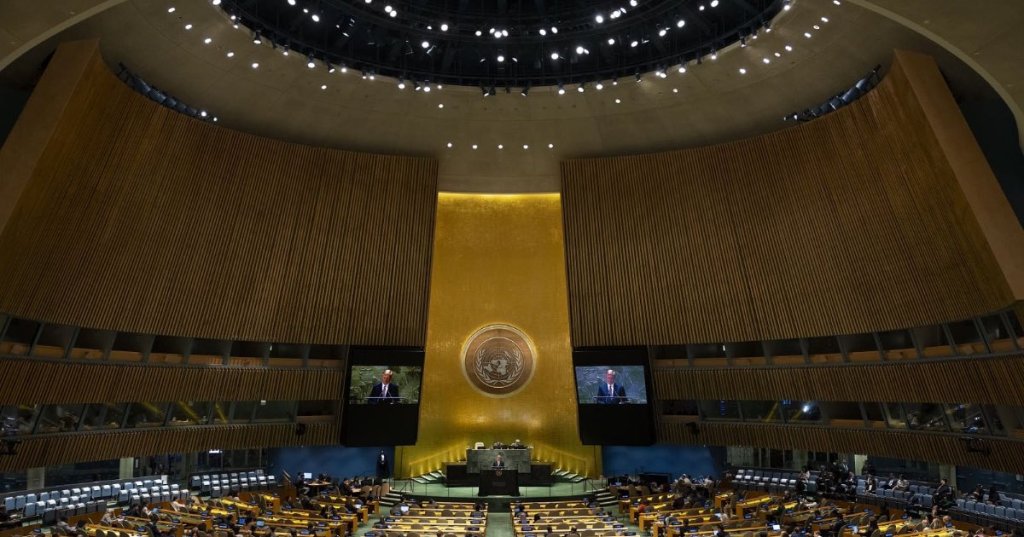
The UN General Assembly has once again voted overwhelmingly to end the US economic embargo on Cuba, with 165 countries in favour, seven against, and twelve abstentions.
The resolution — “Necessity of ending the economic, commercial and financial embargo imposed by the United States of America against Cuba” — reflects widespread opposition to the decades-long sanctions.
• Against: United States, Israel, Argentina, Hungary, Paraguay, North Macedonia, and Ukraine.
• Abstained: Poland, Czechia, Estonia, Latvia, Lithuania, Romania, and others — citing Cuba’s support for Russia amid the ongoing war in Ukraine.
• Poland said the abstention reflected “the selective application of the UN Charter.”
The non-binding resolution, which has been voted on 33 times at the UN General Assembly, is advisory and reflects the stance of the international community.
The US embargo on Cuba was first imposed in 1960, following the nationalisation of American-owned assets by the Cuban government. It was expanded in 1962 into a full trade ban under President John F. Kennedy, and later reinforced through legislation such as the Cuban Democracy Act (1992) and the Helms–Burton Act (1996).
Although restrictions were eased in 2000 to permit limited exports of food and humanitarian goods, the embargo remains in place today — continuing to prohibit most American business and financial transactions with Cuba.
Follow on social media TikTok@tut0ugh Instagram@tut0ugh Threads@tut0ugh X@tut0ugh YouTube@tut0ugh

About tut0ugh – Global Events, Geopolitics & World News
tut0ugh is an independent media platform dedicated to providing clear, accurate, and timely coverage of global events, geopolitics, and international affairs. In a world where information travels quickly and narratives compete for attention, understanding the broader context behind headlines is more important than ever. tut0ugh aims to empower readers with knowledge, insight, and perspective, helping audiences navigate complex global developments with confidence.
Mission
The mission of tut0ugh is to connect individual events to the wider forces shaping the world. From diplomacy and security to trade, alliances, and conflicts, our goal is to provide analysis and context that explain not only what happens but why it matters. By highlighting trends, patterns, and historical precedents, tut0ugh equips readers to understand the implications of decisions, agreements, crises, and conflicts on a global scale. Our content is crafted for clarity, ensuring that both casual readers and specialists can benefit from our reporting.
Editorial Approach
tut0ugh prioritises accuracy, transparency, and independence. All information is sourced from verified and credible outlets, including official statements, reputable media, academic research, and direct reporting. We aim to fact-check rigorously before publication and correct any errors promptly, maintaining transparency for our audience. Opinion and analysis pieces are clearly labeled to distinguish them from straight reporting, allowing readers to separate commentary from factual coverage.
Our coverage spans six main categories: Asia-Pacific, Middle East, Americas, Europe, Africa, and Global developments. This structure allows readers to explore regional and international issues, compare perspectives, and understand how local events influence wider geopolitical trends. By offering both regional and global context, tut0ugh ensures readers can make informed judgments about the forces shaping the modern world.
Why Context Matters
No event exists in isolation. Whether it’s a diplomatic negotiation in Europe, a trade dispute in Asia, or security developments in the Middle East, understanding the wider context is essential. tut0ugh connects individual stories to the larger narrative of international affairs, providing insight into how policies, conflicts, and agreements impact nations, societies, and global stability. Our aim is to provide readers with the tools to interpret the news critically, seeing beyond immediate headlines and short news cycles.
Trust, Transparency & Ethics
tut0ugh operates with editorial independence and integrity. We do not represent governments, political parties, or corporate interests. Editorial decisions are made in the public interest, free from external influence. All content is clearly attributed, with publication dates and author information provided for accountability. When corrections are necessary, they are noted transparently.
Privacy and responsible data usage are integral to our approach. tut0ugh does not sell or trade personal information and employs measures to protect user data. Readers can trust that our platform is designed to deliver information responsibly, ethically, and without bias.
Reader Value
tut0ugh is not only about reporting events; it is about providing meaningful context, helping readers understand global trends, and fostering a more informed public. Whether tracking political developments, economic shifts, humanitarian crises, or security issues, our content explains the “why” behind the news. By consistently delivering well-researched, accessible, and insightful reporting, tut0ugh empowers readers to engage with global affairs confidently.
Stay Connected
Readers are encouraged to explore our full range of coverage, from regional pages like Europe, Middle East, and Asia-Pacific to thematic global insights. Follow tut0ugh on social media, subscribe for updates, and consider contributing as a guest author to join a growing community of informed, engaged readers. By connecting with tut0ugh, audiences gain reliable, context-driven news coverage that prioritises accuracy, transparency, and understanding. –

 tut0ugh